I am a dog mother. While I’m aware that as both an experience and a challenge it’s scarcely comparable to raising and nurturing an exasperating, ever-developing and increasingly complicated homo-sapien, I do feel like a mother. Even pet owners with no interest in human children identify, at least in some sense, as parents to their animals. Research shows that our canine companions trigger similar neural pathways to the parent-baby bond.
Meet Finlay, a mischievous, intelligent, determined, energetic live wire of a Cairn Terrier and Gemma, a docile yet eccentric, emotionally needy while standoffish Cavalier King Charles Spaniel.
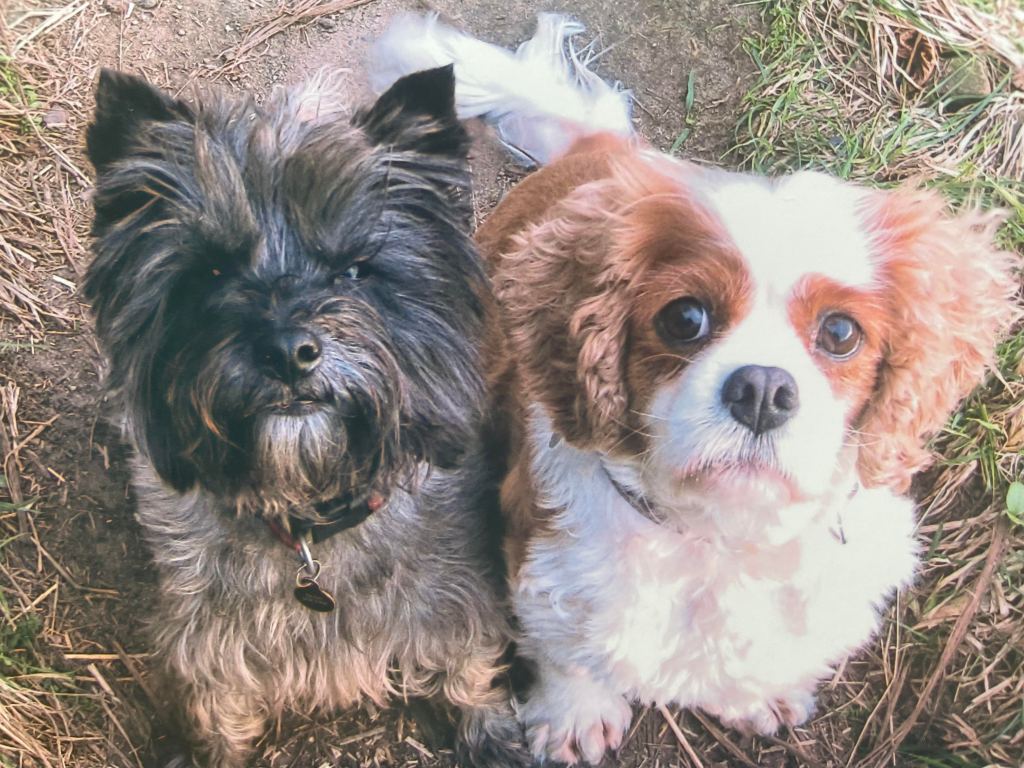
Respectively, their interests include sprinting the length of the garden and chasing balls, and languishing on our Persian rug and relentlessly grasping for every morsel of food available. I love them dearly and they never fail to bring meaning to my life. The problem with all of this is that they’re no longer alive.
In 2008 my mum and I drove to Glossop to collect a Cairn. We’d been open to various breeds, but were soon swayed by an adorable Cairn calendar in a shop. My mum contacted a breeder, and was informed we’d have our pick of two brothers. We followed her into a barn, and surveying the impossibly sweet boys pottering in the hay, there was no ‘obvious’ choice. We justified it by saying that Finlay was ever so slightly cuter, but we may as well have just flipped a coin.
The first day he let us pick him up and carry him around, clinging to us like a little koala as we tidied or made tea. The first night he barked intermittently but settled very quickly over the following days. He would forcefully wriggle out of our arms whenever we went in for the scoop, so that was the end of that. And then came the era of ‘chew and destroy’. No shoe, book, receipt or plug was safe. It was a constant battle.
He was highly extroverted, and not long after adopting him we made the decision to find him a friend, largely to ease the loneliness and boredom when my mum was working or when I was at school. On the hunt for a Cavalier, within a few weeks we happened upon an adoption poster on our local vet’s window. I can recall the key snippets: ‘three and a half’, ‘gentle loving nature.’ ‘Gemma‘. We made the enquiry.
Before we acquired her she lived with a guy in his twenties about whom we knew nothing, who after a short time gave her to his mum Janet, a breeder. Much to her disappointment Gemma flat out refused to interact with the male dogs let alone mate with them. Janet hadn’t even bothered to take a decent photo for the poster. Her eyes were filled with gunk, she was squinting in the sun and was sporting an uncharacteristically shaggy coat for a Cavalier. She looked bedraggled and sad. And then we went to collect her. ‘Here she is,’ Janet said, gesturing to a stunning Blenheim spaniel, retreating in a muddy corner in an apparent attempt to avoid a Rottweiler’s advances.
In the car headed for her new home, she looked around sheepishly and cowered when I went to stroke her, undoubtedly sick of being passed around like a rag doll. The lack of effort and consideration behind that poster photograph really struck a chord. We were resolved to give her the life she deserved, and to usher in the next chapter as quietly and seamlessly as possible.
Unfortunately Gemma was antagonised by her new brother the minute she set foot in the house. He chased her around the garden, growling sotto voce, in order to assert his dominance. We panicked, not knowing how best to intervene, but he settled within an hour or two. For the first few weeks he’d nudge her out of the way whenever we fussed her but that was about the extent of his territory marking. It’s not surprising behaviour when you consider how unsettling it must have been for him. And poor Gemma must have felt she was lurching from one disaster to another.
She was perpetually obsessed with my mum, but by contrast was scared of me for the first couple of years. Having a favourite is a classic Cavalier trait, but we weren’t sure what had sparked her fear. We wondered if she’d been abused in one of her previous homes, perhaps by someone who looked or sounded like me. She hated being ignored while my mum was teaching piano, regardless of the attention I was giving her, and would bark until the music room doors opened. This was a win-win as not only did it appease her but the pupils found her presence soothing. We also discovered we had another plug and paper muncher on our hands, but as she was well past the puppy stage, it was likely due to anxiety.
We had many experiences parallel to losing a toddler in the supermarket. For one, Finlay was an escape artist. We always made sure to properly close the back gate but gardeners and window cleaners and neighbours – who came without warning and hadn’t a clue there was a terrier on the loose – didn’t. On numerous occasions we split up and ran around the neighbourhood until a crippling stitch formed, only to find him casually perusing the meat section in the Co-op or strolling alongside a couple in the woods as if they were his new parents. We also had paranoias around food – chocolate and grapes/raisins being the main culprits as they can be highly toxic to dogs. Once when my mum’s ex’s back was turned, he leapt onto the kitchen table and scoffed an entire stollen cake. We rushed him to the vets, he vomited, and all was well. Gemma once went missing when off lead and thankfully, not possessing the same thirst for adventure as her brother, was back on our front step within ten minutes. But so many near-misses make for perpetually anxious parents, and it was rough. Naturally, I’d give anything to have that anxiety back.
When I was 24 and they’d reached their golden years, I went to Australia for a year and, upon returning, was met with the dog equivalent of a shrug. I stood there for a while, somewhat in shock as they remained silent and stationary in their baskets. I knelt down to stroke them and teased ‘is this the welcome mummy gets after keeping you alive for over a decade?’ and sensed no recognition of who I was or the fact I’d been gone for so many dog years. They made more of a fuss when I came back from work. My mum pointed out that they might have been cross with me, and that’s the narrative I subscribe to. I mean, they can’t have suddenly not cared about my absence. And I know it wasn’t because they’d forgotten me because that wouldn’t matter – they acknowledged total strangers. The idea that they were angry with me for leaving for so long, while it broke my heart in one way, warmed the cockles in another. It demonstrated that they recognised my role in their lives. They knew I was a caregiver and that caregivers aren’t supposed to abandon you. They’d missed me, suffered as a result of my selfishness, and now they were going to snub me. An appropriate reaction really. But things went straight back to normal. ‘Either the snub was all for show or you’ve got very short memories,’ I said, plonking them on the sofa and planting kisses on their heads.
Finlay had a number of problems towards the end, the chief one being diabetes. Credit to my mum for giving him another year without compromising his quality of life – while I was abroad, unaware of how ill he’d become, she radically changed his diet, challenging the vet’s conviction that he needed to be put down as soon as he started deteriorating. Gemma had undetected kidney failure.
I’ve heard it said that love with nowhere to go is pain, and I am a mother in pain. A mother no longer permitted to fulfil her duties. Replenishing the water bowl, strapping up the harness, scooping up the excrement. Simple tasks but also acts of love. A mother no longer permitted to reach for my fur babes whenever I’m feeling insecure and need that wordless, life-affirming comfort. I’ve never believed in magic but I’m certain a dog’s body pressed up against yours, feeling their heart beat through your chest, is the closest we’ll get as a species. I’ll never forget the night I went through a nasty breakup. My immediate instinct was to go to Gemma, and I clung to her, sobbing into her silky coat, verbalising everything I couldn’t bring myself to express to the man who’d hurt me. She’d often pull away when I smothered her, but this time she didn’t. She knew something bad had happened. She knew I needed her support. She, having once been afraid of my face, my voice, my touch, got me through that night.
I almost want to shout from the rooftops that I had two dogs called Finlay and Gemma, that I am forever altered because they were born and I was lucky enough to happen to find them. YOU WILL HEAR THEIR STORY. To me every detail, like the plugs, shoes and books that were destroyed in the early years, the way Finlay would kick me in protest when I stopped scratching his back prematurely, is important. And in order not to forget their importance I have to keep them current by verbalising them. But of course, the world doesn’t care about all the details. Why should it? As many people as there are there are as many personal universes. Everyone is dealing with their own baggage and they can’t carry any more. So I’ve settled for writing this. Fellow dog parents dealing with loss, behold my baggage. Maybe it feels a bit like yours.
However, I’m afraid if you’re seeking advice you might want to look elsewhere because I don’t have any… I just needed to talk about losing my dogs. I just want to talk about my dogs. But what I will say, what I can’t stress enough, is that every emotion connected to your pet’s death is valid. Everyone grieves differently, but additionally I hope you can also find solace in the fact that someone else out there will be experiencing the exact emotions you’re experiencing.
Even before adopting the dogs I knew losing them would be one of my greatest tests – a sort of trauma. It’s a huge reason why, despite every fibre of my being crying out for a new four-legged companion, I am wary of going down that road again. When I’m 80, will Finlay and Gemma be shadowy memories in a long line of many? For my own wellbeing, my own sense of purpose, my own structure, my sense of self, I feel having a dog is a necessity almost like breathing… but I’d hate to reduce them to shadows.
From that first car journey until Gemma’s final day, a daily mission of mine was to hold her paw. She hated it, but I persisted in the hope she’d develop a tolerance. In hindsight I realise this was cruel and selfish, but being deprived of it felt so unnatural. Imagine never getting to hold your child’s hand – I ached. Even when I wasn’t doing things I knew would annoy her, I often sensed a certain disdain, like she was irritated by my never being able to get things right. And I guess it was true. For most of her life I often never knew what she actually wanted. My mum and I would spend hours a day trying to work it out. That was just life with Gemma: an unsolvable puzzle.
When she turned eleven, after Finlay had passed, she would break into barking every other night around four. At first we thought she needed to do her business, but we’d let her out and she would merely amble around the garden. She came back in, however, and stopped barking so, suspecting she’d probably just wanted to stretch her legs, we returned to bed. Within five minutes she was off again. So I’d bring her up with me (by this point she was hard to get up the stairs so that was a mission in itself) and that didn’t placate her either. Having worked in dementia care, I observed that this new behavioural pattern presented like sundowning. We feared her mind was beginning to deteriorate in her old age as well as her senses, and if that was the case and it was anything like sundowning in people, the end was probably in sight. But she had several health checks and the vets said that aside from the slight heart murmur typical of Cavaliers, she was a fairly healthy girl. While I was hyper-aware of her relative frailty and would check she was breathing every time her eyes were closed, this assessment did take a weight off our shoulders.
But we knew something was wrong when she started going off her food. This is generally a warning sign with dogs, and given that food was Gemma’s life-long obsession, it triggered an immediate and intense alarm. The vet examined her thoroughly and discovered she had advanced kidney disease and there was very little to be done. Three days later, we made the decision to have her euthanised. Within a few hours of booking the appointment I watched Gemma, this creature who’d stuck by us, who’d helped us through heartbreaks, who enchanted everyone she met with those saucer eyes and gentle temperament, leave her body. I stared at this four-legged thing lying on a veterinary table that was her while not being her at all, and let out a strange scream. I felt the pain in my chest people describe when they talk about grief. And I was finally able to hold her paw. It was still warm, still felt the same. But for the first and only time, there was no resistance.
While her brother was alive she was consistently submissive. But after he passed she came into her own in a way we hadn’t anticipated. She was more confident in her assertions and desires and I think that’s because she felt empowered to step out of his shadow. As much as we’d always loved Gemma, her character had never been as overt as Finlay’s. He was the leader and it was plain to see on walks. Whatever he did she copied. He sniffed a particular patch of grass, she sniffed it. He picked up the pace, she caught up. While they were far from co-dependent and even appeared to ignore each other much of the time, their bond was evident. Every now and again they’d share a basket despite it being too small for both and spoon. In the face of losing her sibling and friend, and the dynamic they’d shared, she began to shine.
I have a personalised mug with a photo of Gemma and me. It’s not suitable for dishwashing and when she was alive and a little while after she passed I always ensured everyone hand washed it – I couldn’t risk defiling her image. Then once or twice I chanced it, and while I noticed little cracks appearing in the photo and it bothered me, I carried on, seemingly out of habit. When I realised I’d stopped hand washing it entirely a wave of guilt coursed through me. How and why did I start being so careless? On the one hand it is just a mug, and it’s not like I’ve destroyed it – I use it all the time. But on the other why am I not taking the utmost care with it? Perhaps it’s just a sign that I’m moving on? While I struggle with the loss, and while I often still fleetingly ‘hear’ her bark or panic that her water bowl is bone dry, I do accept that they’re gone. I wish I was a more spiritual person, but I don’t believe their souls are floating around the house or watching over me. I believe that they’re gone and that all I have are memories. But that’s ok. Memories aren’t meaningless.
Whether I never get another dog or whether I have ten more in my lifetime, they will never replace Fin and Gem because no dog can be truly replaced. Just like people, they are individuals who leave a unique, permanent mark. They changed me and I hope my love changed their lives for the better. I think making a dog happy is one of life’s greatest gifts and privileges. If you’ve ever loved a dog, if you’ve ever strived to make one happy, I know you’ll feel the same. Hang in there… we’re all in this together.
 PORTFOLIO