If Netflix has taught us anything in recent years, it’s that people can’t get enough of true crime. For many, cosy-nights-in consist of watching reconstructions of people being stalked, shot or slain while chowing down on junk food. Although it’s indexed alongside every other genre, a huge moral question mark looms over its mass production and consumption.
It’s almost ironic that in a society that champions mental health more than ever, we seek out content that, in theory, could potentially make us even more anxious and depressed. This material isn’t derived from fanciful notions – it’s based on very real traumas experienced by people just like us, at the hands of the world’s most depraved individuals. So why are we so often drawn to the darker side of humanity, excited by crimes for which we could become the target, when we can so easily opt for a feel-good comedy or thought-provoking sci-fi?
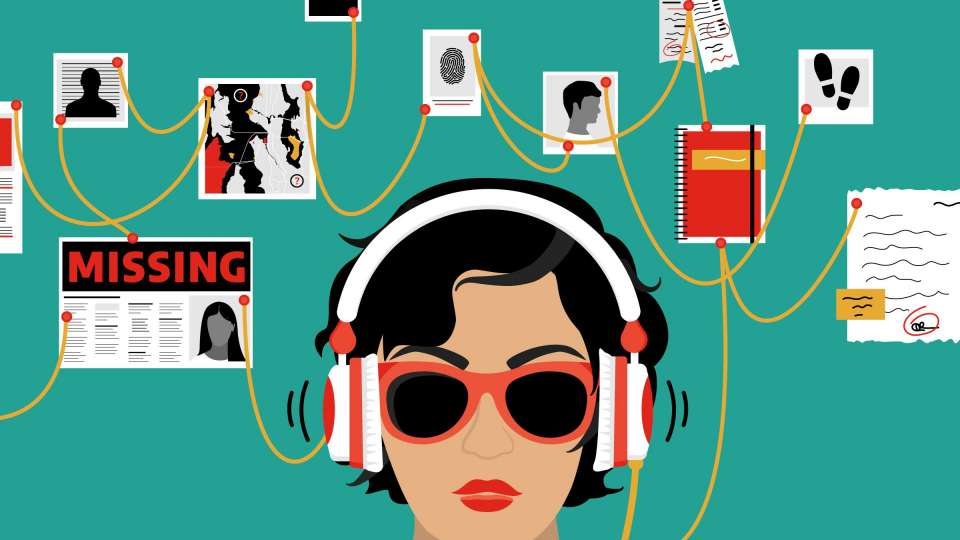
The truth is that we’ve always been fascinated by the unknown. True crime gives us a glimpse into something that’s completely outside of our realm: the minds of individuals who think and operate on a totally different level. It also has all the rudiments of good storytelling: fascinating characters, an intense sense of urgency and finally, tension which, by the end, is resolved. While there is a distinction between true crime and horror, there is also a clear parallel: the thrill of the vicarious fear, the adrenaline, immediately counteracted by the knowledge that it’s not happening to you but someone else, which brings a huge sense of catharsis. Our realities dictate that we deal with unpleasant emotions in an unpredictable environment where the outcome is outside of our control. When we’re removed from a situation, shielded by a screen or a pair of headphones, we know the outcome won’t negatively impact us. Strange as it may sound, perhaps we’re most comforted by the uncomfortable. Emma Dworkin, a trauma researcher and assistant professor at the UW School of Medicine, says: “It’s really common and normal to enjoy things that involve experiencing difficult emotions in safe ways, like rollercoasters and horror movies and sad films.” This is particularly true for women; we make up over half of true crime fans due to our increased sense of vulnerability.
There’s also the fact that we all have different triggers, which means some will be more disturbed by true crime stories than others. My anxieties, for example, pertain to health-related issues. I work on a dementia unit and have had the illness on both sides of my family – naturally, I’m preoccupied enough with the subject and consequently don’t choose to watch shows and films that tackle it. Similarly, if someone close to me had been murdered, true crime content would probably hit too close to home for me to consume it.
So, we have an explanation. But is there a justification?
A key differentiator between horror and true crime is the element of glorification. Many don’t believe in the afterlife and view things such as the Paranormal Activity franchise as pure escapism. They don’t feel that the franchise’s existence is actively damaging a real person’s legacy. Conversely, it stands to reason why dramatizing real crimes aggravates the grief already felt by the living victims. The relatives of Jeffrey Dahmer’s victims expressed upset over the creation of the Netflix series Dahmer – upset compounded by the fact that Netflix hadn’t even consulted them prior to its creation. The series depicts his murders in explicit, utterly excruciating detail, even using the evocative song ‘please don’t go’ by KC and The Sunshine Band during a particularly drawn out killing scene… you have to question the motivation. While it’s arguably worthwhile to explore such crimes in an attempt to understand the perpetrator’s psychology and perhaps prevent future occurences, there’s already an abundance of information available on the story. Profit and acclaim should not have superseded the well-being of those still dealing with the aftermath of the atrocities. Similarly, James Bulger’s mother protested the making of Detainment, a short film which tracked the arrest of her late son’s killers. She had also not been consulted or asked for permission.
Another issue is the messaging. Many true crime shows focus primarily on certain narratives: strangers attacking white cisgender women. In reality, many trans women and women of colour are being attacked at higher rates, and most murders and rapes are committed by people known to the victims. Not understanding this could be instilling a fear in women that disproportionately impacts their choices (which, returning to my earlier point, could in fact be causing anxieties) and doing a disservice to victims whose stories aren’t being told. Additionally, the US has seen a decrease in crime over the last thirty years, but many US citizens believe there to have been an increase. Whether this is borne from the shows themselves or something else, they can only be validating this misconception.
Furthermore, the emphasis that is put on the victims’ actions prior to the crimes could potentially lead to victim blaming. While it’s important to be responsible with regard to your own safety, unfortunately some individuals will do ‘everything right’ and still become victimized. When consuming crime content, it’s vital to remember that the fault always ultimately lies with the perpetrator.
I’m not proud to admit I watched Dahmer in its entirety, despite my initial disgust upon its release. I had always been fascinated with the story and the series looked compelling. I will concede that it highlighted an important and lesser known aspect of the story: Glenda Cleveland, a woman who lived in the apartment building adjacent to Dahmer’s, had persistently contacted police following a sighting of a disoriented teenage boy stumbling out of Dahmer’s apartment. Her daughter and niece had raised the alarm after finding the boy in an alley, but the police wrote it off as a lover’s quarrel and walked the boy back to the apartment where he was subsequently murdered. After noticing missing person posters, Cleveland repeatedly asked for updates, but was shut down at every turn. Had Glenda and her family been taken seriously, six lives could have been spared. This is one of many accounts of police dismissing red flags and in turn facilitating perpetrators to commit further offences, and I’m sure viewers appreciated the recognition of Glenda’s efforts.
So, has the upsurge in true crime content impacted us for better or for worse? I don’t think there’s a straightforward answer. I don’t feel Dahmer should have been made. I do, however, think that documentaries that give us an insight into the minds of psycopaths can help us identify contributing factors and work as preventative tools. Ultimately, it depends on the degree of sensationalisation. If the content’s intention is to is glamorise innocent people’s tragedies and has no sense of justice or honour, it’s most certainly crossing a moral line. But if it’s tasteful and educational, perhaps there’s an argument to be made that – as perverse as it may be to find pleasure in such horrible events – we can in fact benefit from them in the long-term. I also think it’s important to check in with ourselves after consuming this material. Do we feel slightly more anxious than we did before? Is it something that negatively preoccupies us, in a way that goes beyond intrigue? Or do we even start to feel worryingly desensitized to the information we’re absorbing? If so, it’s probably time to evaluate how much time we really wish to spend in that place.
 PORTFOLIO